Overview
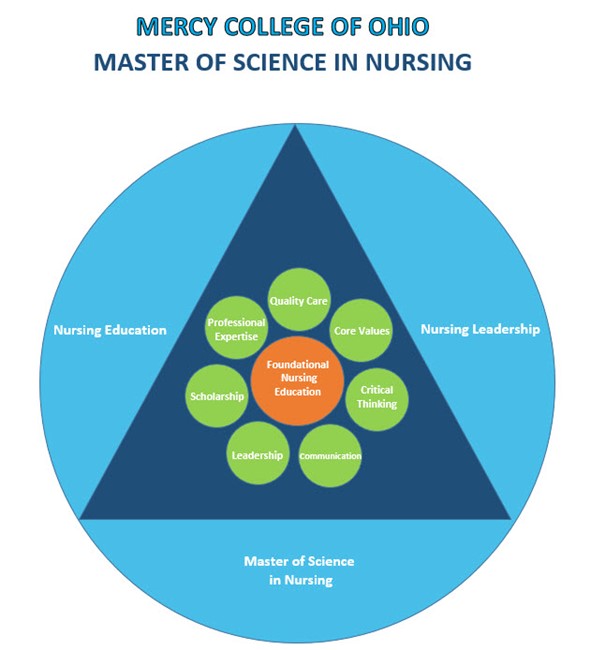
The Master of Science in Nursing (MSN) program offers two focused tracks and prepares baccalaureate nurses for the professional nursing practice role with a focus in nursing leadership, or a focus in nursing education. Graduates are meticulously prepared for nursing practice through a comprehensive and specialized curriculum that combines theoretical knowledge with hands-on practicum experiences. Students develop advanced skills in communication, critical thinking, leadership, and evidence-based practice, fostering their ability to navigate complex healthcare environments, and enabling them to collaborate effectively with interdisciplinary teams, advocate for patients, and assume leadership roles in healthcare organizations. Ethical considerations and a commitment to ongoing professional development are instilled, ensuring that graduates adhere to the highest standards of ethical conduct and stay abreast of evolving healthcare trends. These well-rounded professionals are equipped to excel in diverse healthcare settings and contribute significantly to improving patient outcomes and the nursing profession. A master’s education will allow the nurse to transition into a research or practice-focused doctoral program. The MSN program is built on the College mission, vision, and values.
The Master of Science in Nursing programs are developed within the context of the AACN Essentials. The Essentials provide curriculum guidelines that support a framework for quality within nursing education. The curriculum is designed to provide all courses in an asynchronous, online, distance education platform with the exception of the practicum experiences that will be completed in a geographical location most convenient for the student. Students can complete the program in six semesters by enrolling in six credit hours per semester. The semesters are divided into 7-week sessions; this design allows students to take one course at a time, with the exception of courses taken in the final semester which include the Leadership or Education Practicum and Leadership or Education Capstone II courses which are offered concurrently over 10 weeks. The program of study must be completed within five years as measured by the first semester of enrollment through degree completion.
Nursing Mission Statement
Mercy College of Ohio Division of Nursing prepares quality graduates to care for and serve diverse populations within healthcare systems reaching persons of our communities and global environment through critical thinking, clinical judgement, and scholarship with the evolution and implementation of evidence-based practice. The Division of Nursing inspires students to dedicate themselves to service, intellectual inquiry, social engagement, leadership, and lifelong learning in the spirit of the Mercy values. Through graduate education, the Division of Nursing provides graduates with a greater understanding of the discipline of nursing in order to engage in higher-level practice and leadership in a variety of settings and to commit to lifelong learning.
Goals
The MSN program is designed to:
- Promote excellence in the education of nurses for the advanced role as leaders and educators in healthcare.
- Cultivate Christian values of compassion, excellence, human dignity, justice, sacredness of life, and service in the profession of the nurse leader and nurse educator.
- Prepare graduates for the advanced role in nursing leadership and/or nursing education through the application of nursing theory and evidence-based practice.
- Foster self-direction in pursuit of lifelong learning, and personal and professional development.
- Prepare graduates to address top priorities in global health based on needs and emerging health issues.
Program Learning Outcomes
Upon completion of the MSN program the graduate will:
- Model ethical leadership, integrity, and professionalism in advanced nursing practice, fostering personal and professional growth while contributing to the well-being of patients, nursing teams, and the broader healthcare system. (Domains 2, 9, 10)
- Synthesize advanced knowledge from nursing and other sciences to influence healthcare quality and outcomes for diverse populations, utilizing evidence-based strategies, policy advocacy, information technology, and systems-level interventions. (Domains 1, 3, 7, 8)
- Evaluate culturally sensitive, evidence-based, and ethically sound care strategies that address the diverse needs of individuals and families, improving outcomes across the lifespan. (Domain 1, 2, 4, 5)
- Appraise advanced critical thinking and clinical judgment to assess, diagnose, and manage complex patient care situations, utilizing evidence-based approaches to optimize patient outcomes and ensure safety. (Domains 1, 2, 4, 5, 8)
- Facilitate interprofessional collaboration and communication, promoting teamwork and shared decision-making to enhance patient care outcomes and improve population health across diverse settings. (Domains 3, 6, 7, 10)
- Integrate theory, scholarly inquiry, and research findings into advanced nursing practice, through critical appraisal and application of the evidence to deliver safe, quality person-centered care. (Domains 1, 2, 4, 5, 8)
Admission Requirements
In addition to the graduate program application requirements, students seeking admission to the MSN program must:
- Submit official transcripts from higher education institution(s) where the original nursing degree was earned (Associate of Applied Science, Associate of Science, and/or Bachelor of Science in Nursing degree), and any subsequent coursework thereafter.
- Possess a degree in nursing at the bachelor’s level or higher with a minimum 3.0 cumulative GPA (on a 4.0 scale) for full admission or a minimum 2.3 cumulative GPA (on a 4.0 scale) for provisional admission from a professionally-accredited (ACEN or CCNE) program and an institution that is approved/accredited by a historically regional accreditor. An applicant with a minimum of 3.0 cumulative GPA (on a 4.0 scale) from an institution that is approved/accredited by a historically national accreditor may be granted provisional admission.
- Provide additional transcripts, if an applicant has less than 40 credit hours on the bachelor degree granting transcript.
- Submit official transcripts from the bachelor degree-granting higher education institution and all graduate-level transcripts.
- Provide Registered Nurse (RN) License Verification of an active, unencumbered RN license.
- Submit a current professional resume or curriculum vitae.
Requirements for Clinicals or Professional Practice Experience
Criminal background checks, drug screens, health records, and titers/immunizations are required prior to the start of the clinical program. Clinical program requirements and instructions are maintained on the College website at https://mercycollege.edu/background. This Policy can be found at https://mercycollege.edu/about/compliance-consumer-information.
Students must hold an active, unencumbered RN license in the state where clinical practice experiences are held. Therefore, we are unable to accommodate students who only hold RN licensure from the following states: Florida, Illinois, and New York.
Degree Requirements
The MSN curriculum is a 36-credit hour program of study that is designed to be completed in six semesters. Courses are offered in 7-week sessions, so students can take one course at a time, with the exception of the courses offered in the final semester which include the Leadership or Education Practicum and Leadership or Education Capstone II course that are offered concurrently over 10 weeks.
Complete all of the following for the Master of Science in Nursing Education Track:
| NUR 510 | Theoretical Foundations for Professional Nursing Practice | 3 |
| NUR 515 | Research and Evidence-Based Practice | 3 |
| NUR 520 | Healthcare Policy in the Global Community | 3 |
| NUR 525 | Population-Based Healthcare | 3 |
| NUR 530 | Informatics and Healthcare Technologies | 3 |
| NUR 536 | Teaching and Learning Strategies in Nursing Education | 3 |
| NUR 541 | Advanced Nursing Curriculum Design | 3 |
| NUR 546 | Evaluation Methods in Nursing Education | 3 |
| NUR 551 | Integrated Advanced Pathophysiology, Physical Assessment, and Pharmacology | 3 |
| NUR 556 | Education Capstone I | 3 |
| NUR 561 | Education Practicum | 1-3 |
| NUR 566 | Education Capstone II | 3 |
| Total Credit Hours: | 36 |
NUR 525 and NUR 561: Practicum hours are based on a 15-week semester and are calculated as one credit hour for every 40 hours. Example: Education Practicum is 2.5 credit hours. Practicum hours are calculated as: 2.5 X 40 = 100 total hours.
Complete all of the following for the Master of Science in Nursing Leadership Track:
| NUR 510 | Theoretical Foundations for Professional Nursing Practice | 3 |
| NUR 515 | Research and Evidence-Based Practice | 3 |
| NUR 520 | Healthcare Policy in the Global Community | 3 |
| NUR 525 | Population-Based Healthcare | 3 |
| NUR 530 | Informatics and Healthcare Technologies | 3 |
| NUR 535 | Leadership and Strategic Management for Advanced Nursing Roles | 3 |
| NUR 540 | Systems-Based Practice for Nurse Leaders | 3 |
| NUR 545 | Strategic Management of Human Resources | 3 |
| NUR 555 | Financial Management in Healthcare | 3 |
| NUR 550 | Leadership Capstone I | 3 |
| NUR 560 | Leadership Practicum | 1-3 |
| NUR 565 | Leadership Capstone II | 3 |
| Total Credit Hours: | 36 |
NUR 525 and NUR 560: Practicum hours are based on a 15-week semester and are calculated as one credit hour for every 40 hours. Example: Leadership Practicum is 2.5 credit hours. Practicum hours are calculated as: 2.5 X 40 = 100 total hours.
MSN Leadership Track Sample Program of Study
Semester I
| NUR 510 | Theoretical Foundations for Professional Nursing Practice | 3 |
| NUR 515 | Research and Evidence-Based Practice | 3 |
Semester II
| NUR 520 | Healthcare Policy in the Global Community | 3 |
| NUR 525 | Population-Based Healthcare | 3 |
Semester III
| NUR 530 | Informatics and Healthcare Technologies | 3 |
| NUR 535 | Leadership and Strategic Management for Advanced Nursing Roles | 3 |
Semester IV
| NUR 540 | Systems-Based Practice for Nurse Leaders | 3 |
| NUR 545 | Strategic Management of Human Resources | 3 |
Semester V
| NUR 550 | Leadership Capstone I | 3 |
| NUR 555 | Financial Management in Healthcare | 3 |
Semester VI
MSN Education Track Sample Program of Study
Semester I
| NUR 510 | Theoretical Foundations for Professional Nursing Practice | 3 |
| NUR 515 | Research and Evidence-Based Practice | 3 |
Semester II
| NUR 520 | Healthcare Policy in the Global Community | 3 |
| NUR 525 | Population-Based Healthcare | 3 |
Semester III
| NUR 530 | Informatics and Healthcare Technologies | 3 |
| NUR 536 | Teaching and Learning Strategies in Nursing Education | 3 |
Semester IV
| NUR 541 | Advanced Nursing Curriculum Design | 3 |
| NUR 546 | Evaluation Methods in Nursing Education | 3 |
Semester V
| NUR 551 | Integrated Advanced Pathophysiology, Physical Assessment, and Pharmacology | 3 |
| NUR 556 | Education Capstone I | 3 |
Semester VI
The Master of Science in Nursing degree will be awarded to students who have successfully completed all required coursework in the graduate nursing curriculum, have a minimum of 36 credit hours, and have fulfilled all other requirements for graduation.
Students are required to complete two practicum experiences during the curriculum. The first is associated with one of the foundation courses: NUR 525 Population-Based Healthcare course (1 credit hour = 40 hours), and the second is associated with one of the specialty focused track courses, either NUR 560 Leadership Practicum course (2.5 credit hours = 100 hours), or NUR 561 Education Practicum course (2.5 credit hours = 100 hours).